AI Isn’t the Problem — Your Lack of Structure Is: Why Generic AI Content Happens, and How Frameworks Fix It

Introduction — The Illusion Of Ai Content
Everyone thinks AI is the solution to content overwhelm.
Tools promise:
- “Instant content”
- “Unlimited ideas”
- “Post in seconds”
And coaches jumped in, expecting clarity, quality, and conversion.
Instead, this happened:
- Posts started sounding the same
- Audiences became numb
- Engagement dropped
- Conversations disappeared
- Brand identity dissolved
- Content became “AI-flavored vanilla”
AI didn’t ruin content.
AI simply revealed a truth:
👉 Your content was never about writing.
It was about thinking — and AI can’t think for you.
This article explains why AI content is generic by default and why only frameworks can train AI to produce content that sounds like YOU.
Why AI Creates Generic Content (The Hidden Mechanism)
Most people assume AI writes generic content because:
- it’s not trained enough
- prompts are weak
- models are flawed
But the real reason is much deeper:
AI mirrors structure — not genius.
AI does not create strategy.
AI does not create a voice.
AI does not create meaning.
AI creates patterns.
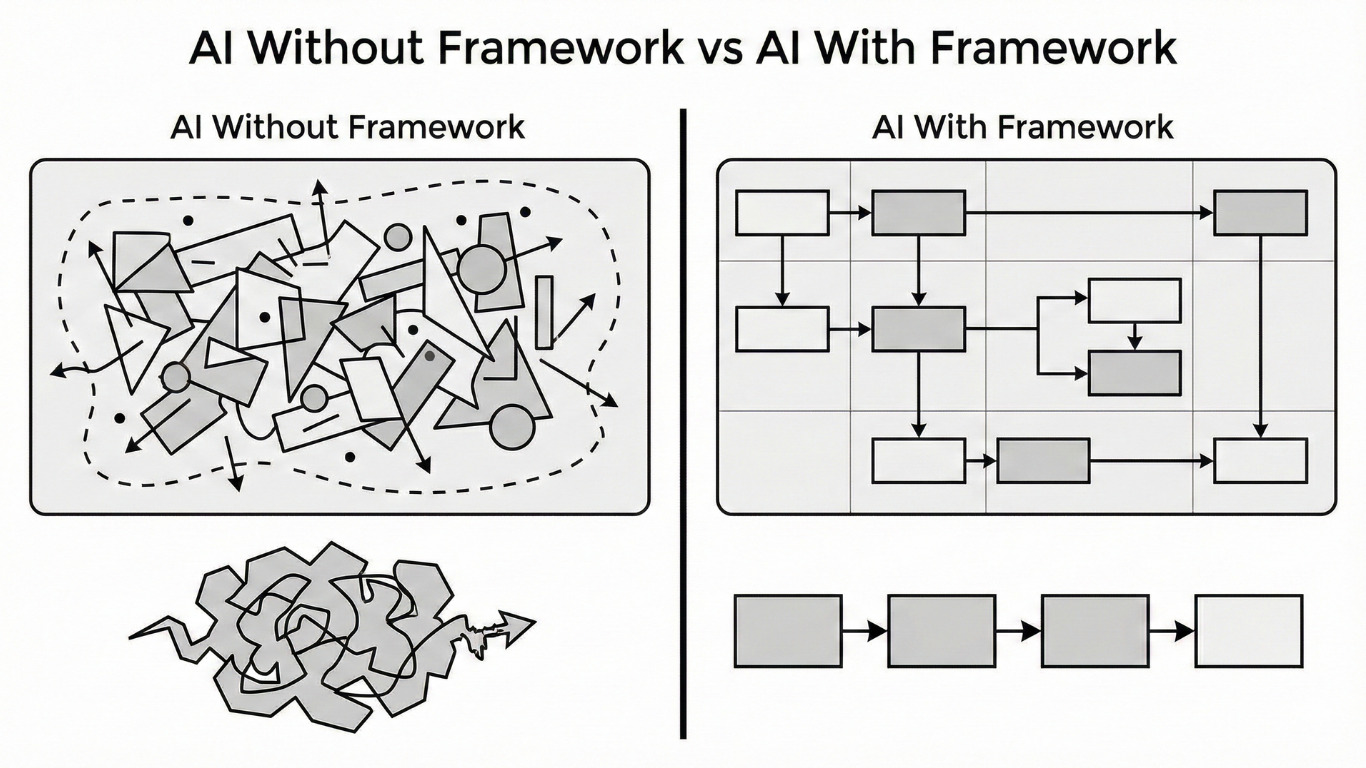
If your patterns are unclear → AI amplifies confusion.
If your patterns are generic → AI amplifies generic output.
Let’s break this down.
Problem 1: AI Thinks In Surface Patterns, Not Depth
Humans communicate emotionally.
AI communicates statistically.
When you ask AI:
“Write a post about motivation.”
It pulls:
- common phrases
- generic advice
- internet patterns
- repeated structures
Result: A post that reads fine but says nothing.
This is because AI doesn’t understand:
- your belief system
- your audience psychology
- your emotional tone
- your storytelling rhythm
- your brand identity
Without these, AI defaults to average output.
Problem 2: Unstructured Prompts Make AI Sound Confused
When coaches prompt AI with:
- “Write a Facebook post about confidence”
- “Give me an Instagram caption about growth”
- “Create a blog about productivity”
They ask AI to think.
But AI doesn’t think — it reconstructs.
Unstructured prompts → unstructured output.
The missing piece is:
👉 A framework that tells AI HOW you think.
Problem 3: AI Doesn’t Know Your Voice
Humans speak with:
- emotional rhythm
- pacing
- tension
- emphasis
- identity
- nuance
AI doesn’t know any of that until you train it.
And “training” AI doesn’t happen with prompts.
It happens with frameworks that define:
- your tone
- your belief system
- your narrative logic
- your emotional sequence
- your language patterns
Without this, AI defaults to template language.
Problem 4: AI Cannot Create Positioning
Your brand positioning is based on:
- your worldview
- your experience
- your values
- your unique philosophies
AI doesn’t know your positioning unless you give it a structural blueprint.
This is why many coaches sound:
- the same
- interchangeable
- bland
- forgettable
AI cannot create differentiation.
But a framework can.

The Reality: AI Is Not The Problem — Your Inputs Are
Here’s the truth:
AI is a mirror.
It reflects:
- your clarity
- your structure
- your emotional intelligence
- your thinking model
If you give AI unstructured input → AI creates unstructured output.
If you give AI a framework → AI produces content that is:
- ✔ consistent
- ✔ on-brand
- ✔ emotionally resonant
- ✔ persuasive
- ✔ structured
- ✔ unique
AI becomes powerful ONLY when guided.
Why Frameworks Fix Every AI Content Problem
A content framework is a thinking system that organizes:
- how you speak
- what you believe
- how you persuade
- how you structure ideas
- how you sequence emotions
When you feed this to AI, three things happen:
- AI learns your voice blueprint
Your tone becomes consistent across posts, emails, ads, blogs, landing pages.
This creates brand gravity. - AI produces content that feels alive
Frameworks teach AI how to build tension, emotion, narrative flow, punchlines, pacing.
Suddenly your content feels human again. - AI follows a predictable persuasion pathway
Frameworks define the hook, the angle, the emotional core, the logical sequence, the action step.
This turns AI into a conversion assistant, not just a writer.

The Core Visual Comparison: AI Without Framework Vs. AI With Framework
Action Steps: How To Train AI Using Frameworks
Here are the 3 essential steps to transform AI from generic to brilliant:
- STEP 1 — Build Your Voice Map
Document your tone, phrases, emotion types, sentence rhythm, belief patterns.
This becomes your AI’s “personality.” - STEP 2 — Define Your Narrative Sequences
Every piece of content must follow a persuasion sequence:
hook → tension → insight → shift → action.
You teach this to AI via examples + patterns. - STEP 3 — Use Framework-Based Prompting
Instead of saying:
❌ “Write a post about confidence.”
You use frameworks:
✔ “Use my emotional shift pattern. Speak to this pain. Follow this structure. Maintain this tone.”
AI becomes predictable, powerful, and on-brand.
Conclusion — AI Is Not Your Writer, It’s Your Amplifier
AI is not here to replace you.
AI is here to scale you.
But only if you give it:
- structure
- clarity
- identity
- narrative logic
- emotional fingerprints
- consistent frameworks
Once you do that, AI becomes the most powerful creative tool you’ve ever used.
And frameworks become the bridge between your brilliance and AI’s speed.
FAQ
Because AI mirrors unclear inputs. Without structure or emotional logic, AI writes in statistical averages.
Frameworks give AI a thinking model — tone, emotion, structure, and persuasion patterns.
No. You need structure. Frameworks remove skill dependency.
No. With frameworks, AI amplifies your voice instead of replacing it.
Yes — but only if you give it a voice blueprint or framework.
Templates are static. Frameworks adapt to your voice and scale across any content type.
Let’s Start a Conversation
Contact
Every growth journey begins with clarity. Whether you’re a Coach ready to build a lead engine or a creator ready to build your story, let’s explore how my frameworks can help.
© Uday Salvi